 NEWS
NEWS
Apple M6 Chip Reveals What to Expect From A20 Pro and iPhone 18 Pro
 09/07/2026
 30
30
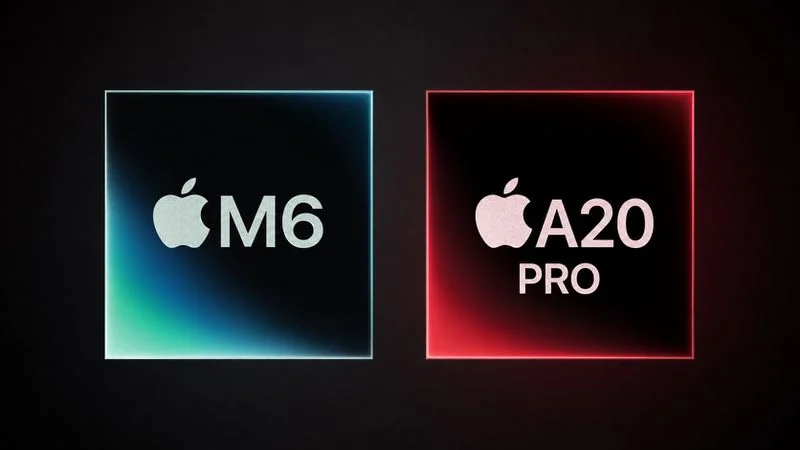
Apple unveiled its new M6 chip on August 25, ahead of its September iPhone event. While the M6 is designed for the Mac, its architecture provides an early look at what Apple could bring to the A20 and A20 Pro chips powering the upcoming iPhone 18 lineup.
Apple's A-series and M-series chips typically share many architectural technologies. This year, however, the M6 arrived before the expected A20 Pro, giving us an unusual preview of Apple's next-generation iPhone silicon.
Recent reports suggest that the A20 Pro could be up to 18% faster and 30% more power efficient than the A19 Pro. Here's what the M6 may tell us about Apple's next iPhone chip.
A20 Pro Could Be Apple's First 2nm iPhone Chip
The M6 is Apple's first chip built using TSMC's second-generation 2nm N2 process, and the A20 is widely expected to follow.
The smaller manufacturing process allows Apple to fit more transistors into a similar area, potentially delivering higher performance while improving power efficiency.
Apple has traditionally introduced major new manufacturing nodes with its A-series chips because the enormous iPhone production volume helps validate manufacturing yields. The M6 arriving first therefore represents a notable change.
More importantly, the M6's use of the 2nm process provides a shipping-product example of what Apple's move to 2nm chip technology could mean for the A20 and A20 Pro, rather than relying solely on analyst predictions.
A20 Pro Could Get a More Powerful Neural Engine
Apple's Neural Engine has remained at 16 cores since the A17 Pro, but the M6 introduces a major change with a dual 16-core Neural Engine.
Apple says its system frameworks can address both Neural Engines simultaneously, potentially delivering up to 2x the peak AI computing performance of previous generations.
This could be particularly important as Apple continues expanding on-device AI and Apple Intelligence.
The M6 also reportedly uses wafer-level multi-chip module (WMCM) packaging, which places memory closer to the processor components. This can reduce the distance data needs to travel and potentially improve AI workloads.
However, the dual Neural Engine may require additional space and thermal headroom, so it remains unclear whether the feature will make its way into the A20 Pro.
GPU AI Improvements May Be More Modest
The M5 introduced Neural Accelerators in every GPU core, resulting in a major increase in AI-related GPU performance compared with the M4.
The M6 continues that architecture with a more incremental improvement, delivering nearly 30% higher GPU AI performance than the M5.
The A19 Pro made a similarly large AI leap over its predecessor for the same architectural reason. As a result, the A20 Pro may focus more on refining the existing Neural Accelerator architecture rather than delivering another dramatic generational jump.
A20 Pro Could Bring Better Graphics Performance
The M6 also introduces several graphics-related architectural improvements, including:
●50% higher geometry rates
●Updated shader core architecture
●Improved Dynamic Caching
●Hardware-accelerated ray tracing
These technologies are likely to influence Apple's A-series chips as well, since Apple has historically carried many graphics architecture improvements across its M-series and A-series chips.
This could mean the iPhone 18 Pro receives meaningful improvements in gaming, graphics-intensive applications, and other GPU workloads.
Memory Bandwidth May See Only a Modest Upgrade
Memory bandwidth is particularly important for on-device AI, as it determines how quickly data can move between memory and the processor.
The M6 supports up to 170GB/s of memory bandwidth, compared with 153.6GB/s on the M5 — an increase of around 10%.
That relatively small improvement suggests Apple may continue using faster LPDDR5X memory rather than moving to the newer LPDDR6 standard.
Reports indicate that Apple is sourcing high-speed LPDDR5X memory for the iPhone 18 lineup, which would be consistent with the M6's memory strategy.
The A19 Pro currently offers around 76.8GB/s of memory bandwidth. If Apple achieves a similar 10% increase with the A20 Pro, bandwidth could reach approximately 85GB/s.
However, improvements to packaging such as WMCM could potentially have a larger impact on AI performance than memory bandwidth alone by reducing the distance between memory and processing components.
A20 Pro Is Unlikely to Add AV1 Encoding
The M6's Media Engine supports hardware acceleration for H.264, HEVC, ProRes, and ProRes RAW, along with AV1 decoding.
However, the chip still does not support hardware-accelerated AV1 encoding, matching the M5.
Since Apple has retained this limitation even with the new M6 architecture, an AV1 encoding feature in the A20 Pro appears unlikely.
What the M6 Tells Us About the A20 Pro
The M6 doesn't reveal every detail about Apple's upcoming iPhone 18 chips, but it provides several useful clues.
The A20 Pro could combine Apple's 2nm manufacturing process with improved GPU architecture, more efficient AI processing, faster memory, and potentially new packaging technology.
Rather than another massive leap in AI performance, the next-generation chip may focus on better efficiency, sustained performance, and improved on-device AI capabilities.
With the iPhone 18 lineup expected to arrive later this month, Apple should soon reveal exactly how much of the M6 architecture makes its way into the A20 and A20 Pro.
Source: Macrumors